


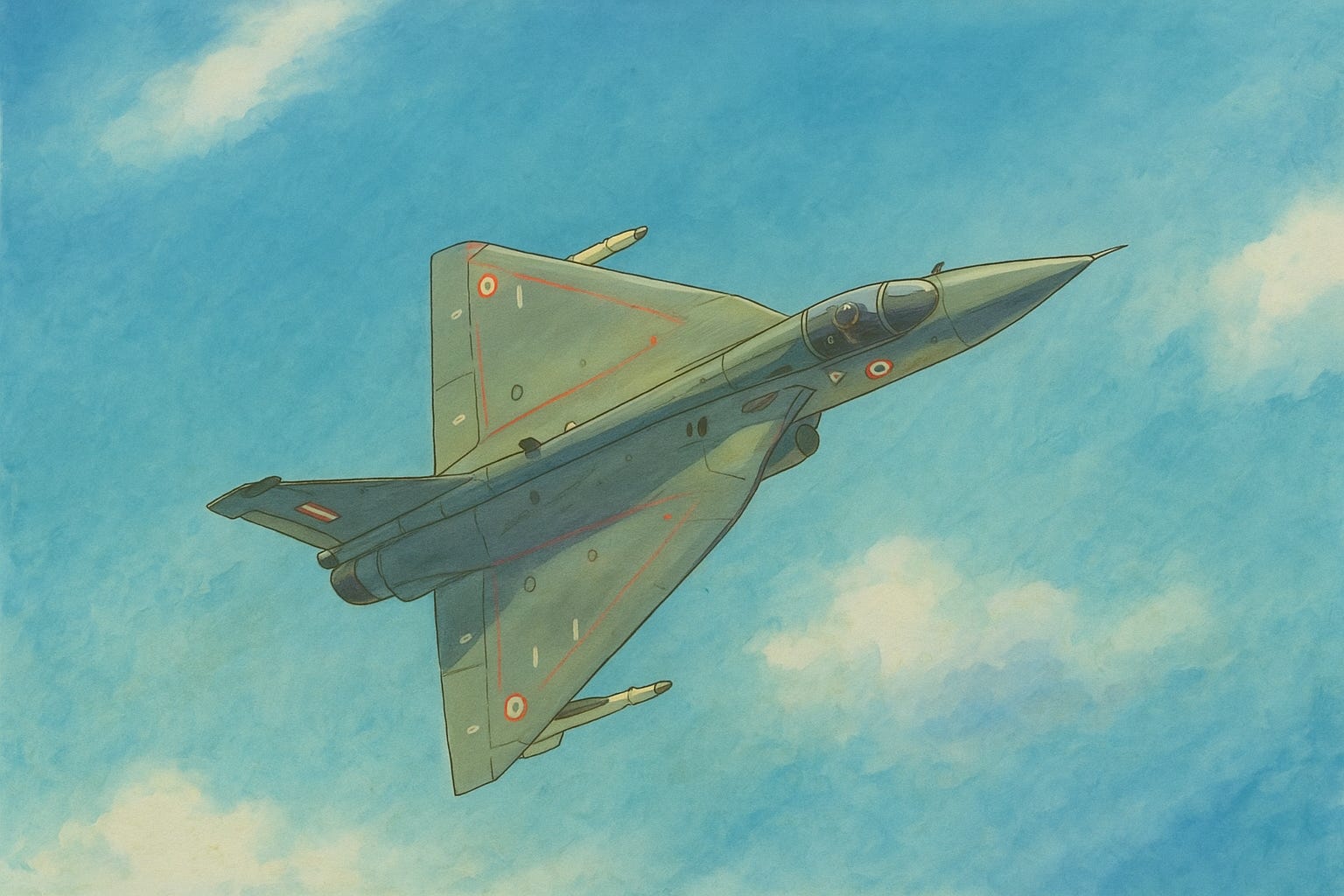
India has manufactured thousands of fighter jets over four decades.
Entire factories built. Hundreds of billions of rupees spent. Massive industrial infrastructure created. Tens of thousands of jobs generated.
And what strategic capability did India gain from licensed production?
According to the man who designed India’s only indigenous fighter from scratch: “Nothing.”
That’s not hyperbole. That’s the technical assessment of Dr. Kota Harinarayana, programme director and chief designer of India’s Light Combat Aircraft (LCA) Tejas Programme, in a revealing interview with Republic TV.
As India retires the MIG-21 and foreign defense manufacturers circle with proposals—particularly Russia’s Su-57 under the seductive label of “Make in India”—Dr. Kota delivered the most important warning Indian policymakers need to hear:
“Licensed production will never make you an operationally capable air force or a country which can deliver the kind of decisive power, air power that you look for.“
..
The ₹2 lakh crore experiment that failed
Here’s India’s licensed production track record:
💥 MIG-21 FL, MIG-23 MF, MIG-27 FL - Licensed production
💥 Sukhoi-30 MKI - Licensed production
💥 Jaguar, Hawk trainers - Licensed production
“We manufactured all these aircraft,” Dr. Kota recounted. “Have you got anything out of that? Nothing.“
Nothing.
Not “limited capability.” Not “some technology transfer.” Not “partial autonomy.”
Nothing.
..
Why licensed production is a sophisticated trap
Dr. Kota, who actually redesigned the MIG-21 comprehensively—”we are the only people in the whole world who modified the MIG-21, not externally, including aerodynamic structure, systems, everything”—understands what foreign partners will never tell you:
Licensed production creates the illusion of self-reliance while cementing permanent dependence.
“Every small change you want to do on that aircraft, it will be a big effort,” he explained.
Here’s the reality:
🔴 Want to integrate an Indian missile? Foreign approval required.
🔴 Want to upgrade the radar? Hope the original manufacturer agrees.
🔴 Want to fix a design flaw? You can’t access engineering blueprints.
🔴 Want operational adaptation? Queue for negotiations that may never conclude.
India doesn’t get design capability. India doesn’t get upgrade freedom. India doesn’t get strategic autonomy.
India gets an expensive assembly line and a permanent leash held by foreign suppliers.
“Just don’t waste our time in those kind of things,” Dr. Kota said bluntly. “Ramp up our capability.”
..
The lobbies that keep selling the same lie
Why does India keep falling for licensed production?
“There are groups of people who want to denigrate so that they can sell a foreign aircraft in India,” Dr. Kota revealed. “And there is not a small lobby. It is a big lobby. That lobby is there in parliament. That lobby is outside. Everywhere.“
This isn’t new. It’s systematic.
In 1984, when India’s LCA program was just beginning, the Russian defense minister told the Indian defense minister: “Your people cannot produce any LCA. They will produce you a paper and call it LCA.”
The threat followed: “If I were in your position, I would have dismissed your director, your boss.“
A foreign power was directly pressuring India to abandon indigenous development.
Why? Because every indigenous fighter India builds is one less licensed production deal. One less maintenance monopoly. One less avenue for geopolitical leverage.
The pressure never stopped. It just changed forms.
..
The Su-57: Licensed production trap 2.0
Right now, prominent publications are promoting manufacturing the Su-57 with Russia as “Make in India.”
Dr. Kota’s response: “You should not make a mistake of buying such an aircraft. Never, never make such mistake.“
India already tried partnering with Russia on the Su-57. HAL teams visited Russia for joint development.
What happened? “The Russians were unwilling to open up and talk anything about that.“
The Indian Air Force concluded they wouldn’t get anything of strategic importance. The partnership died.
Now Russia is back—not offering joint development, just licensed production. The same trap with a new label.
“If we do that, all our stories will become just a laughing stock,” Dr. Kota warned.
..
What actually breaks the licensed production trap
Here’s what licensed production never gives you: Design freedom and weapons integration autonomy.
The LCA has both.
“You can put any weapon system from any country in the world on the LCA,” Dr. Kota emphasized. “We have demonstrated it again and again. Nothing equal to that anywhere in the world.“
With licensed production, every weapons integration requires foreign approval. Want to put an Israeli missile on a Russian jet? Negotiate. Want an Indian-developed bomb on a Western platform? Hope they agree.
The LCA has no such chains. Indian weapons. Israeli weapons. French weapons. American weapons. Whatever India’s strategic situation demands.
That’s what indigenous development delivers. That’s what licensed production can never provide.
..
The choice that will define the next 40 years
India has two paths forward:
Path One: Buy the Su-57 under “licensed production.” Spend billions. Remain dependent on Russian approval for every modification, every weapons integration, every operational adaptation. Repeat the pattern that delivered “nothing” over the past 40 years.
Path Two: Support the LCA ecosystem. HAL has three production lines. Private industry—L&T, Tata—is engaged. Production is ramping to 24-30 aircraft annually, meeting Air Force requirements.
“Next year LCA Mark 2 will fly. I have zero doubt in my mind. After 3-4 years we’ll have the AMCA,” Dr. Kota said. “We have the technology. We have the capability.”
But this path only works if India doesn’t sabotage itself with “emergency” foreign purchases that kill the indigenous ecosystem.
Dr. Kota’s message was unambiguous: “We should not fall into that trap—neither American trap or any other Western trap. You can buy equipment, engine—we have to get out in 10 to 15 years. But never make the mistake of buying one more fighter aircraft from outside.“
..
Forty years of evidence is conclusive
Licensed production creates jobs—but not strategic capability. It builds factories—but not design freedom. It assembles aircraft—but not operational autonomy.
It’s a sophisticated trap designed to keep India as a customer, not a creator.
The man who actually built India’s indigenous fighter understands this intimately. The question is whether policymakers will listen before India commits another ₹2 lakh crore to proving the same failure one more time.
Licensed production doesn’t work. It has never worked. It will never work.
Stop falling for it.
..
This article is based on an interview with Dr. Kota Harinarayana, programme director and chief designer of India’s Light Combat Aircraft (LCA) Tejas Programme, given to Republic TV.
Whoever wrote this is a genius (hope its not chatGPT :P).
Writing with such clarity and explaining the issue the way you've done is just too good.
Phenomenal article by Team Swarajya.
Sea Power & Air Power are foundations of military strength, No country will help you develop it. One has to develop it indigenously.
Tejas & AMCA, along with Kaveri Engine should be the foundation of Air Power.