

ISRO Is Retreating From Launches. Is That The Point?
The agency that put India in space is handing the keys to startups.

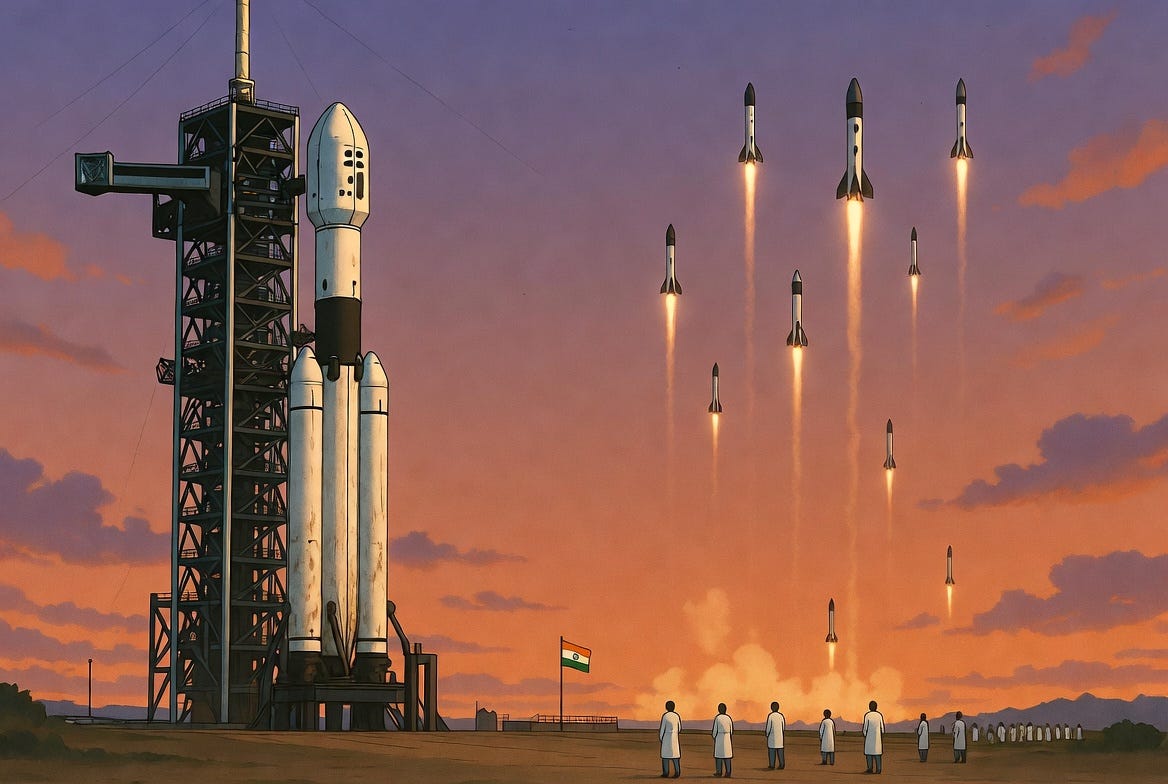
ISRO launched four rockets this year. One failed. Critics are furious about the low count.
Here’s what they’re missing: this isn’t incompetence. It’s strategy. India’s space agency is deliberately stepping back from the launch business—so that private industry can step in. The low numbers aren’t a bug. They’re a feature of a transition that’s been brewing for years.
..
Let’s get the facts straight first. Of ISRO’s four 2025 launches, three succeeded—the January GSLV flight delivering a NavIC navigation satellite, the July NISAR mission with NASA, and the November LVM3 launch placing a communication satellite in orbit. The lone failure was the May PSLV mission, which aborted mid-flight due to a chamber-pressure anomaly in the third stage. Not one of these was a commercial mission.
The target was 30 launches between January 2024 and March 2025. They managed around eight. That’s roughly a 73% shortfall. So yes, the criticism about cadence is valid. But here’s where context matters.
..
ISRO’s rockets—PSLV, GSLV—were never designed for mass production. They’re hand-assembled vehicles from decades-old designs. You can’t roll them off a production line like SpaceX does with Falcon 9. At roughly $2,600 per kilogram to orbit, Falcon 9 is so cheap that even Indian startups choose to fly American. ISRO’s former chairman admitted it bluntly: “Rockets are built and kept in stock, but not finding customers.”
The agency has capacity three times higher than demand. That’s not a manufacturing problem—it’s a market problem. And ISRO’s response has been strategic withdrawal rather than futile competition.
..
Here’s where the real shift is happening. ISRO has fundamentally changed how it operates. Earlier, satellites were built speculatively—launch first, find users later. Now, every launch requires a committed customer before ISRO proceeds. This kills vanity metrics but eliminates waste.
Meanwhile, the agency is redirecting its best minds toward what only a national space agency can do: Gaganyaan (India’s first crewed mission, targeting 2028), Chandrayaan-4 (lunar sample return), the Bharatiya Antariksh Station, and landing an Indian on the Moon by 2040. The unglamorous work of routine satellite launches? That’s being handed to the 350-plus space startups now operating in India.
Prime Minister Modi has set the target: 50 launches per year within five years. One rocket every week. That’s only possible if private industry industrialises production of LVM3 and SSLV—ISRO’s newer, more production-friendly vehicles. Sixty-plus LVM3 rockets are already approved for private-sector manufacturing.
..
The next 12 months tell the real story. Multiple missions are lined up through March 2026. The Rs 27,000-crore SBS-3 surveillance constellation—52 satellites over five years—kicks off soon after. A new spaceport at Kulasekarapattinam will add capacity for 20-25 smallsat launches annually.
ISRO’s quiet year isn’t decline. It’s the lull before transformation. The agency that built India’s space capabilities from scratch is now betting that stepping aside will build something bigger: an entire industry.
Whether that bet pays off depends on what happens next—not on what happened this year.
Credit: Based on reporting by Karan Kamble | Swarajya
ISRO gets results, that it because it still has a cadre of excellent engineers and scientists that want to do good. Thats where my praise ends.
ISRO is no model of a company well run. If ISRO was in Silicon Valley, it would be IBM or at best Oracle, not Meta, not Google, certainly not OpenAI or any of the other well run companies. I have spoken to enough ISRO scientists to realize that it is being run like every other Indian bureaucracy, I.e., a shitshow of politics, process and delays. It takes the ambitious young Indian population and then grinds their ambition down to paste, and makes a mockery of them, the fact that the initial ambition is so high means they still ship, after lengthy delays but that doesn’t change the nature of the organization.
It would be a good thing if ISRO has a shakeup and is run more like a startup. Closing down ISRO is not helpful either, because private industry is not going to invest large capex’s into space, or at least they have not shown the will for it. What it needs, is an organizational reboot, a new CEO who actually rules like a CEO, fires the paper pushers, promotes the ambitious young men of ability and strives to explore and reach space. We have plenty of such CEO’s to choose from, imagine if we could Sundar Pichai to do this as his retirement job, let’s think big!