

India Is Bankrolling Three Space-tech Startups Across The Valley Of Death
The government chips in the cash, takes no stake, lets the founders keep the patents — and gets paid back only from a share of future sales.


In the space business, the hardest part often comes after you’ve built the thing.
You’ve made something clever in the lab. Now it has to become a product someone will actually buy — years of testing, tweaking and proving it won’t fail in orbit.
That long, expensive slog is where most deep-tech ideas quietly succumb, because private investors won’t wait that long and the only early customer is usually the government.
There’s a name for this graveyard: the valley of death.
On 11 June, IN-SPACe announced the first three companies it’s helping across it — Bengaluru’s Astrobase and SatSure, and Hyderabad’s TM2SPACE — under its Rs 500 crore Technology Adoption Fund.
..
The fund is cannily built. It picks up to 60 per cent of a project’s bill — capped at Rs 25 crore — to carry a technology from “works in the lab” to “ready to sell.” The government takes no stake in the company. The founders keep the IP. It simply earns its money back over time, through a share of whatever the product eventually sells.
The only catches: you can’t use this money to build the thing with foreign partners, and you need IN-SPACe’s nod before licensing the technology to anyone else, at home or abroad.
..
Look at what got funded and a pattern jumps out.
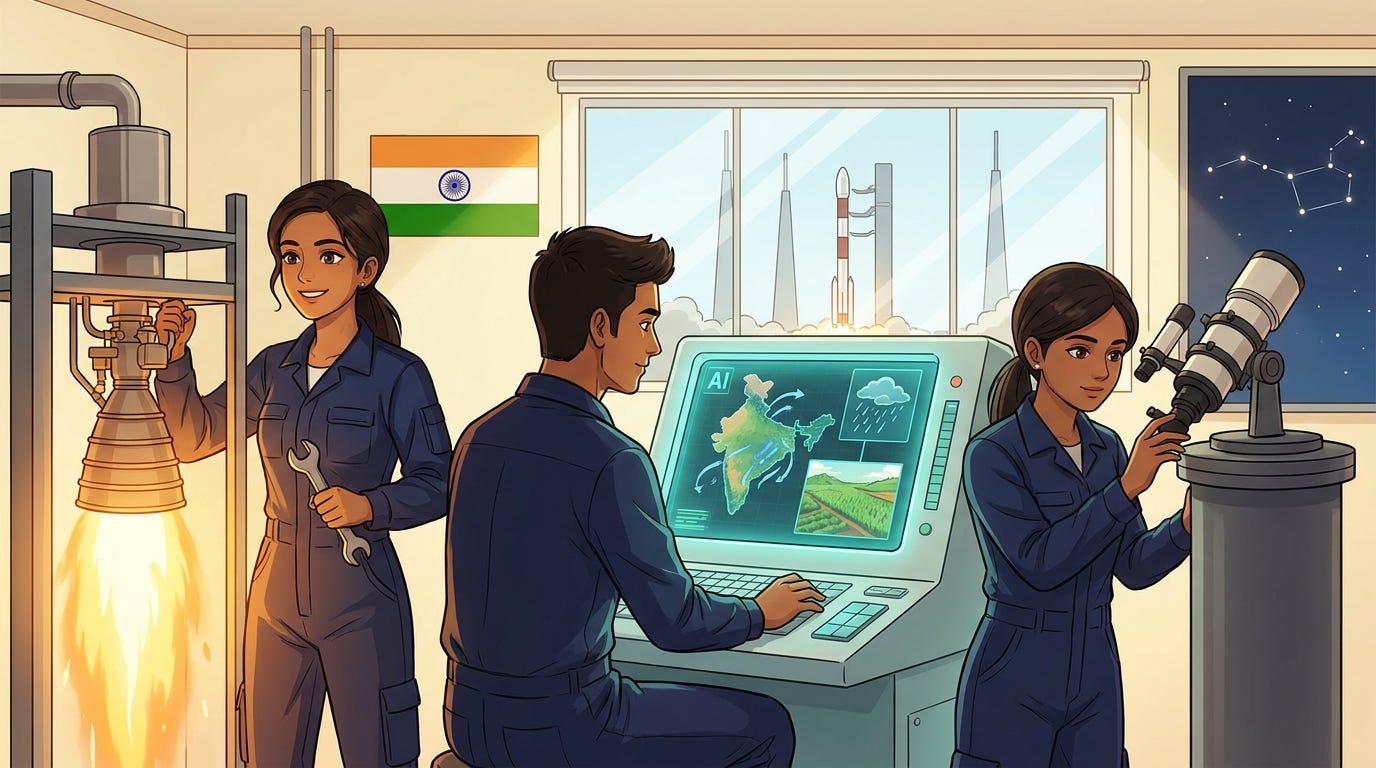
Astrobase is building a powerful, reusable rocket engine — one of the trickiest designs in the world, with very few built anywhere — and is already firing it on the test stand.
SatSure is building Dhaarini, what it calls India’s first sovereign Earth-intelligence model — an AI trained on India’s own monsoons, farms and cities to make sense of the flood of satellite images India collects: spotting stressed crops, tracking floods, keeping an eye on infrastructure.
TM2SPACE is making the small star-reading sensors that keep a satellite pointed the right way.
An engine, a brain, and a sense of direction — three things India has struggled to build well enough at home. Which is the whole point: the fund exists to cut that dependence.
..
The design is clever. Now let’s do the maths. SatSure’s grant came to Rs 24.6 crore — just shy of the cap — and the three were chosen from 43 proposals. At Rs 25 crore a pop, the entire Rs 500 crore pot can back only about 20 projects over five years — and so far, 16 months in, it has backed three. Hold that against the dream it’s attached to: a $44 billion space economy by 2034, talk of India becoming the world’s third great space power after the US and China, a separate Rs 1,000 crore venture fund.
Union Minister Jitendra Singh has put the logic plainly — India can’t out-spend China on science, so it has to win on brains instead.
..
That’s exactly what this fund is: small, sharp, founder-friendly, aimed squarely at the spot where Indian deep-tech — or actually, deep-tech anywhere — keeps stalling.
 | A guest post by
|
I know Astrobase well. The founder is experienced, and the management team is professional and motivated. Truly believe they could find the holy grail here.