

Spark 1: India Can Build Submarines. So Why Have We Ordered None In Nine Years?
Part of our year-end series revisiting Swarajya's most important investigations—stories that illuminate why India underperforms its potential, and what it would take to change.

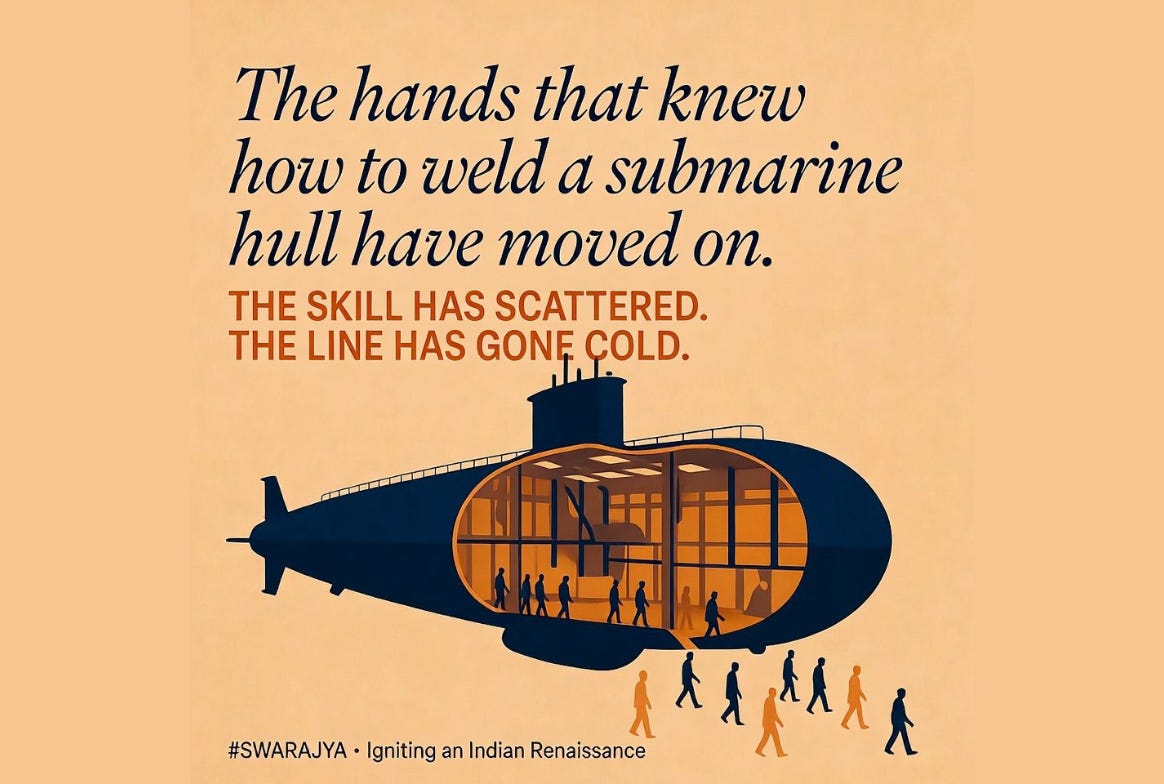
Civilisations flourish when they can develop, build, and sustain military capability of their own.
This is not a controversial proposition. Nations that outsource their security are, in the final analysis, nations that have outsourced their sovereignty. The ability to defend what you build is not a luxury to be acquired when budgets permit; it is the precondition for building anything worth defending.
India can build submarines. This is not aspiration, not five-year-plan optimism, not PowerPoint fantasy. It is demonstrated fact. By the time Mazagon Dock finished assembling the fourth Scorpene-class boat, the shipyard’s chairman could declare what every Indian should want to hear: “I did not need any assistance. The remaining four we made ourselves.”
One is therefore entitled to ask why, in the nine years since, India has ordered precisely zero new submarines.
The question is not rhetorical. It demands an answer, and the answer—as our writer Prakhar Gupta discovered in his investigation—is more dispiriting than simple incompetence. India, it turns out, has perfected the art of abandoning capability the moment it is acquired.
Consider what it takes to build a submarine. Not the raw materials or the money—India has both—but the human expertise. A submarine hull must be welded to tolerances that keep men alive hundreds of metres below the surface. The pressure hull does not forgive errors. The men who learn to do this work do not acquire the skill from manuals; they acquire it from years of practice, from building boat after boat, from the institutional memory that accumulates when a production line runs continuously.
Manohar Parrikar understood this better than most. In 2016, with the bluntness that was his signature, he warned that India’s submarine programme was drifting toward catastrophe—not for want of money, but for want of continuity.
“If a welder is not in touch for more than three months, he has to be recertified,” he observed. “All the people who build submarines have to be kept continuously busy.”
His words were filed away with the efficiency that Delhi reserves for inconvenient wisdom.
Nine years later, the production line has gone cold. The welders who learned to seal submarine hulls to the tolerances that keep men alive underwater have long since found other employment. The engineers who understood the combat systems have retired or scattered to the private sector. The institutional memory—that fragile, precious, irreplaceable thing—has dissipated.
A submarine production line, you see, is not a tap you turn on and off at will. It is a living organism of skill, and India has allowed it to starve.
The follow-on programme, Project 75I, was supposed to prevent exactly this scenario. It was meant to begin while Scorpene production was still underway, ensuring continuity of expertise. Instead, it has spent a decade drifting from one bureaucratic sandbank to another. Committees have deliberated. Files have migrated between ministries. Requirements have been revised, re-revised, and revised again. Not a single steel plate has been cut.
The story of how we got here is, in its essentials, a story of technology transfer that transferred very little.
The French were happy to take India’s money. They were considerably less enthusiastic about sharing the knowledge that would allow India to design its own submarines. What India received, in the memorable phrase of one Navy veteran, was “screwdriver technology transfer”—drawings were handed over, and Indian workers assembled what the French had designed.
The limits of this arrangement became apparent in ways both petty and profound. When MDL engineers needed to modify a single line in the design by one centimetre, the request had to travel to Paris and back. During missile firing trials—the final validation before a submarine enters service—French technicians would arrive with their laptops and snap them shut the moment an Indian engineer approached.
India, in short, learned to build what the French designed. It did not learn to design the next boat itself.
It is instructive, at this point, to consider what happened elsewhere.
South Korea began its submarine journey at almost exactly the same time as India, with almost exactly the same starting point: German Type 209 designs, licensed production, ambitions of eventual indigenisation. The difference is what happened next.
Seoul kept its production line running. Each successive boat incorporated lessons from the previous one. Engineers who built the first boats trained the engineers who would build the next generation. Skills accumulated rather than scattered. Institutional memory deepened rather than dissipated.
Today, South Korea operates twenty-one submarines across three classes. It has moved from licensed production to indigenous design. It exports submarines to other nations.
India, meanwhile, operates an aging fleet and waits for the next foreign partner to sell it the next generation of boats it will assemble but not design.
The difference between these two outcomes is not talent. Indian engineers are every bit as capable as their Korean counterparts. The difference is that Seoul kept building while Delhi kept deliberating.
There is, it should be said, some reason for cautious optimism. Project 75I, despite its interminable delays, may yet materialise. The deal being negotiated with Germany’s ThyssenKrupp reportedly includes genuine design transfer—not merely the right to assemble, but the knowledge to modify and eventually to design independently.
But even if the contract is signed tomorrow, the first boat will not arrive until 2032 or 2033. The skilled workforce that built the Scorpenes will not be waiting. They will have to be rebuilt from scratch, trained anew, brought back up to the certifications that lapsed years ago.
This is the true cost of letting a production line go cold. Not just the submarines you didn’t build, but the capability you allowed to wither. The hands that knew how to weld a submarine hull have moved on. The skill has scattered. The line has gone cold.
Why does this matter beyond the narrow world of defence procurement?
Because submarines are not an isolated case. The pattern Prakhar Gupta documents—capability demonstrated, then abandoned; expertise built, then scattered; programmes launched, then left to drift—recurs across Indian industry and Indian governance. It is the pattern of a nation that can achieve extraordinary things in bursts but cannot sustain them; that celebrates breakthroughs but neglects the patient, unglamorous work of institutionalisation.
A renaissance—if that word is to mean anything—requires more than isolated achievements. It requires the capacity to build and keep building, to accumulate capability rather than squander it, to maintain momentum across decades rather than electoral cycles.
This is what Swarajya means when we speak of igniting an Indian Renaissance. Not cheerleading for India, but asking why a nation capable of landing on the moon cannot seem to keep a submarine production line running. Not outrage for its own sake, but diagnosis as a precondition for cure.
Prakhar Gupta’s investigation is one such diagnosis. We commend it to you—not because it makes for comfortable reading, but because understanding why systems fail is the first step toward making them work.
..
Read the full investigation here: Why India Still Cannot Build Conventional Submarines On Its Own: A Chronicle Of Avoidable Failure
What's wrong with the continuous negativity in this publication especially as regards India's serious intent and efforts at developing strategic autonomy ?
Had Prakhar Gupta really tried to do any serious research himself and has this publication confirmed his "research" independently?
You asked why a nation capable of landing on the moon cannot seem to keep a submarine production line running. Quite right. Can the question be reversed? A nation launching satellite to the moon or launch 6100 tonnes of Bluebird, is it right policy to rein in satellite launches by ISRO to open the field for private entrepreneurs? How did they satisfy that satellite building and launching expertise of a level equal to ISRO were available? How do they assume ISRO's expertise will not suffer attrition and eventual atrophy?
Is there something seriously wrong or deficient in our envisioning development and sustenance of skills? Whose incompetence is casting this long shadow - political leadership, bureaucratic control through non-expert short tenure holders monopoly
or the academic and skill training institutions inflexible monovision?
Your research is provokative. Good. But it is not comprehensive or deep. It stops at excelling in journalistic appeal.